Russian Writers’ Tiflis
The viceroy’s palace, churches and Molokans
In 1829 the authorities had Pushkin watched in Tiflis, while its people threw him a feast in a garden across the Kura, and he remembered no merrier day.

Russian writers found Tiflis a city of the viceroys of the Caucasus: after Georgia was joined to Russia the viceroys lived here, and the avenue by which people came from Russia bore the name of one of them. Russian writers passed through on their way to war and to exile: Griboyedov found a wife here, Pushkin baths more luxurious than any he had known, Lermontov painted Tiflis and Mtskheta, Tolstoy began “Childhood” here, and Gorky printed his first story. The Molokans were resettled in Georgia, and Tbilisi still has a Molokan Square. The military cathedral on the main avenue is gone, but the viceroy’s palace, the Russian churches, the Pushkin garden and the Griboyedov Theatre still stand.
Walking route
The places on the map can be seen in one walk, for instance in this order.
- Sioni Cathedral
- ≈ 580 m · 8 minThe Pushkin garden: close by, at No. 5 Pushkin Street, stood the inn where Pushkin lived; the present house was built in the early 20th century
- ≈ 480 m · 7 minThe Writers’ House
- ≈ 650 m · 9 minThe viceroy’s palace: next to it is the Parliament, on the site of the military cathedral, and at the start of the avenue the Griboyedov Theatre, inside the Galleria Tbilisi shopping centre
- ≈ 970 m · 13 minSt Michael of Tver
- ≈ 1070 m · 15 minThe house where Tolstoy lived
- ≈ 580 m · 8 minSt Alexander Nevsky
- ≈ 570 m · 8 minMolokan Square
- ≈ 550 m · 8 minThe Gorky plaque
Distances and times are approximate, in a straight line between the points; along the streets the way is a little longer.
Timeline
- July 1828 Griboyedov proposes to Nino Chavchavadze
- 22 August 1828 Griboyedov and Nino are married
- late May 1829 Pushkin arrives in Tiflis
- 6 August 1829 Pushkin leaves Tiflis for good
- 1837 Lermontov in Tiflis
- 1840s The road to Russia is named Golovin Avenue
- 1841–1850 The Molokans are resettled in Georgia
- 1845 By the theatre’s account, the Russian theatre is founded
- 1845–1847 According to the heritage register, the viceroy’s palace is built
- 1 November 1851 Tolstoy arrives in Tiflis
- 1863–1864 The church of St Alexander Nevsky is built
- 1860s Simonson rebuilds the palace
- 1867 The Molokan community splits
- 1871 The military cathedral is founded
- 1880 The street is named after Pushkin
- 25 May 1892 Pushkin’s bust is unveiled
- 12 September 1892 “Kavkaz” prints “Makar Chudra”
- 21 May 1897 The military cathedral is consecrated
- 1911–1913 The church of St Michael of Tver is built
- 26 May 1918 The Act of Independence of Georgia is adopted in the viceroy’s palace
- February 1921 The cadets are buried in the cathedral’s grounds
- 7 February 1930 The military cathedral begins to be taken down
- 1932 By the Georgian Soviet Encyclopedia, the Russian theatre is founded
- 1957 Ilia II takes his vows in the Nevsky church
Pushkin in Tiflis
on the mapAt the end of May 1829 Pushkin came to Tiflis. He was on his way to the war with Turkey, to the army in the field, without the authorities’ leave. He was still on the road when the commander-in-chief, Paskevich, ordered the military governor of Tiflis to be warned of the coming of “the well-known versifier, the retired official of the tenth class Alexander Pushkin”, and to have “proper watch” kept over him.
“I put up at an inn,” Pushkin writes in “A Journey to Arzrum”. Where exactly still exercised the people of Tiflis seventy years later. In 1899 the historian E. G. Weidenbaum listed three versions — the inn, Matassi’s hotel, and a room in Tsurinov’s house on Erivan Square — and chose none of them. The Georgian Wikipedia, following the encyclopedia “Tbilisi”, puts a two-storey inn with a carved wooden balcony on the site of today’s No. 5 Pushkin Street. That house was pulled down in 1905–1906; the present one was built in the early 20th century and bears a memorial plaque.
The next day he went to the baths. At the entrance sat the owner, an old Persian; he opened the door, and Pushkin saw more than fifty women, “half-dressed and not dressed at all”. “Come along, come along,” said the owner, “today is Tuesday, the women’s day. Never mind, no harm done.” Pushkin was washed by the bath attendant Hassan, “a noseless Tatar”: he laid him out on the warm stone floor, broke his limbs, stretched his joints and pounded him with his fist — “I felt not the slightest pain, but a wonderful relief.” Which bath he described, Pushkin did not say. The Georgian Encyclopedia says only that visitors to the baths are still shown a room called “Pushkin’s”.
Never in my life, neither in Russia nor in Turkey, have I come across anything more luxurious than the baths of Tiflis.
According to K. I. Savostyanov, the whole of Tiflis society resolved to give a feast in Pushkin’s honour, and Savostyanov himself was charged with arranging it. He chose a vineyard garden outside the town, across the Kura. The garden was lit with coloured lanterns and wax candles on the leaves of the trees, and the guest’s monogram was set up in the middle; more than thirty hosts of the feast waited for him at the entrance. The zurna and a European orchestra played, the lezginka was danced, the Georgian songs “Akhalo” and “Alaverdi” were sung, and a mournful Persian song. When the orchestra struck up the march from “La Dame blanche”, Pushkin was crowned with a wreath of flowers and lifted onto shoulders. “I do not remember a day on which I was merrier than today,” he said; they feasted until morning.
Pushkin stayed in Tiflis about two weeks and on 10 June left for the army. Of the people of Tiflis, the “Journey” names only Sankovsky, the publisher of the “Tiflis Gazette”: he told Pushkin about the country, “loves Georgia and foresees a brilliant future for her”. On 1 August Pushkin came back from Arzrum, spent several more evenings “in gardens to the sound of music and Georgian songs”, and on 6 August left Tiflis for good.
The Pushkin garden
Half a century later the city began to answer his memory. In 1880, on the proposal of the councillor Niko Nikoladze, the street where the inn had stood was named Pushkin Street. In 1885 a garden was laid out by Erivan Square, on the site of the Sunday market. In 1890 the police chief L. A. Rossinsky brought the city council 2,281 roubles collected by subscription for a monument. The bust was modelled by the Tiflis artist Felix Khodorovich and cast in St Petersburg, and the pedestal was built of red and grey Kutaisi stone. The planned inscriptions were dropped and only the poet’s name kept, but even the words “Alexander Sergeyevich” would not fit and were replaced by initials. The monument was unveiled on Monday 25 May 1892, at one in the afternoon.

Sources (11)
- А. С. Пушкин, «Путешествие в Арзрум», глава 2
- А. С. Пушкин, «Путешествие в Арзрум», глава 5
- Е. Г. Вейденбаум, «Хронологическая канва к кавказскому путешествию А. С. Пушкина», 1899
- Е. Г. Вейденбаум, «О пребывании Пушкина на Кавказе в 1829 году», 1899
- Е. Г. Вейденбаум, «Памятник Пушкину в Тифлисе», 1908
- В. В. Вересаев, «Пушкин в жизни»: письмо К. И. Савостьянова
- Грузинская энциклопедия: Пушкин
- Википедия (ka): Улица Пушкина
- Википедия (ka): Бюст Пушкина в Тбилиси
- Википедия (ru): Улица Пушкина (Тбилиси)
- Реестр памятников Грузии: улица Пушкина, 5
Griboyedov and Nino
on the mapGriboyedov’s death and his grave on Mtatsminda are told in the story of the mountain. In the summer of 1828 he was in Tiflis on his way to Persia. In July he dined with his old friend Praskovya Akhverdova — “it was on the 16th”, he later wrote to Bulgarin. Opposite him sat fifteen-year-old Nino Chavchavadze, the daughter of the Georgian poet Alexander Chavchavadze. “I kept looking at her, fell to thinking, my heart beat fast.” Rising from the table, he took her by the hand: “Venez avec moi, j’ai quelque chose à vous dire.” They went into her mother’s house next door; Nino wept, then laughed, he kissed her, her mother, her grandmother and Akhverdova blessed them, and a courier was sent to her father in Erivan. Her father answered with his blessing.
The Chavchavadze family was then renting a small wing from Akhverdova, next to her big house. The house stood in the middle of a garden, and above it, “halfway up the mountain, like a bird’s nest”, hung the monastery of St David — so a contemporary wrote. The gardens were cut down in the 1850s and a street, now Machabeli Street, was laid through them. On the site of Akhverdova’s house, at No. 13 Machabeli Street, stands a house built in 1903–1905, which is now the Writers’ House of Georgia.

The wedding at Sioni
on the mapThe wedding took place on 22 August 1828. According to the historian A. P. Berge, they were married in Sioni Cathedral. The bride’s father was away at the war. Griboyedov himself had gone down with a fever on 6 August: “Nina did not leave my bedside, and I married her.” Until 9 September, when the young couple left for Persia, Tiflis celebrated them.
But on the very day of the wedding, already under the crown, the fit came over me again.
Lermontov and “Mtsyri”
Early in 1837, after his poem “Death of the Poet”, the cornet Lermontov was arrested and transferred at the same rank to the Nizhny Novgorod dragoons, who were fighting in the Caucasus. Where he lived in Tiflis and whom he met, nothing certain is known. The Lermontov Encyclopedia supposes he was here from October to early December 1837 and lodged with a distant relative, Akhverdov, on Sadovaya Street. The Georgian Wikipedia, following the encyclopedia “Tbilisi”, passes on another tradition: that he lived in a house on today’s Lermontov Street.
At the end of 1837 he wrote to his friend S. A. Raevsky: “There are lots of good fellows here, especially in Tiflis there are very decent people; and the real delight here is the Tatar baths!” He drew what he saw: the Metekhi castle above the cliff, women on a flat Tiflis roof, and in oils a general view of the city from the left bank of the Kura, with Metekhi on the right, the Ortachala gardens on the left and Narikala in the middle. He gave this painting to a relative, General Petrov; its manner and the Petrov family’s tradition say it is his.

The monastery of “Mtsyri”
The Caucasus and Georgia stayed in his verse, and the best known of those poems is “Mtsyri”. It begins: “Not many years ago, / There where, as they flow together, / Embracing like two sisters, / The streams of the Aragvi and the Kura roar, / There stood a monastery.” Lermontov did not name the monastery. The Lermontov Encyclopedia sees in it Jvari, the ancient church on the hill above the meeting of the Aragvi and the Kura, opposite Mtskheta. Lermontov painted this view in oils: the rivers meet below, and across the river the outline of Jvari can be seen. The word “mtsyri” itself, the poet explained, means in Georgian “a monk not in service, something like a novice”.

Where Mtsyri himself came from was told in 1887 by the poet’s biographer Pavel Viskovatov, from what his relatives said. Wandering along the old Georgian Military Road, Lermontov is supposed to have met a lonely old monk in Mtskheta. He was a mountaineer by birth; as a child he had been taken prisoner by General Yermolov, who carried him along and left the sick boy with the monks. He grew up in the monastery, pined for the mountains, ran away, and after one escape lay ill for a long time. How true this is, scholars dispute, and the Lermontov Encyclopedia names another possible model: the painter Pyotr Zakharov, a Chechen by birth, who was taken prisoner as a child and brought to Tiflis by Yermolov.
Tolstoy in the German colony
on the mapOn 1 November 1851 the Tolstoy brothers, Nikolai and Lev, arrived in Tiflis. Lev wanted to enter military service: to sit an examination here and go back to the Cossack village of Starogladovskaya on the Terek. His brother soon left, and Lev stayed. “Tiflis is a very civilised town which apes Petersburg a great deal and succeeds very well in imitating it,” he wrote to his aunt in French. There is a Russian theatre and an Italian opera, “which I enjoy as far as my small means allow”.
He lodged in the German colony across the Kura: “it is a suburb … a charming spot surrounded by gardens and vineyards, so that here one feels oneself in the country rather than in town”, and for two fairly clean rooms he paid five silver roubles a month. He was ill nearly all the time and stayed indoors for two months, until the New Year. “I spent that time dully, but quietly and usefully — I wrote the whole first part,” he later noted in his diary. It was the first part of “Childhood”, his first novella. In January 1852 he left for the Terek.
The house where, by some accounts, he lived stands at 52/54 Agmashenebeli Avenue; the heritage register dates it to 1827.

Gorky: “Makar Chudra”
on the mapOn 1 November 1891 Alexei Peshkov, by his passport a journeyman house painter, came to Tiflis. He found work in the railway workshops. Here he met the revolutionary A. M. Kalyuzhny, who after hard labour worked as a statistician in the railway administration; he listened to Peshkov’s spoken stories and urged him to write.
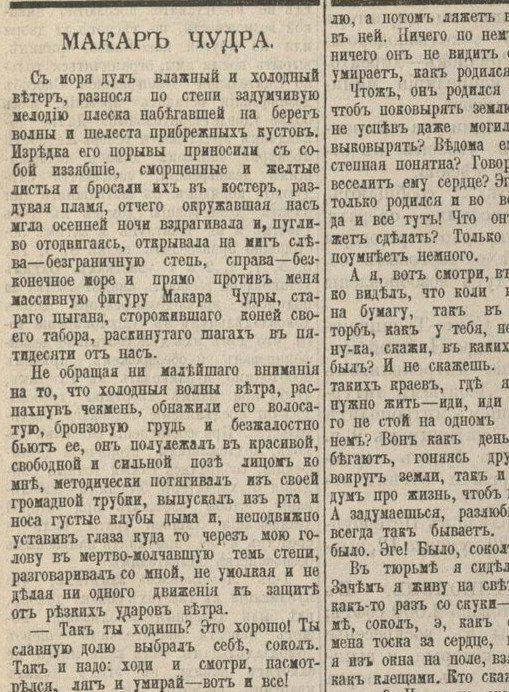
On 12 September 1892 the Tiflis newspaper “Kavkaz”, No. 242, printed his story “Makar Chudra” on its second and third pages — the story of an old Gypsy, of Loiko Zobar and Radda. Under it stood the signature “M. Gorky”: it was the first time he signed with that name. A plaque on a house in Tsinamdzghvrishvili Street reads: “In this house in 1892 lived the great Russian writer Maxim Gorky <…> Here his first story, ‘Makar Chudra’, was written.”
The viceroys’ city
on the mapThe empire’s power in Tiflis lived on the main street. The road by which people came from Russia was known unofficially as “the road to Russia”; in the 1840s it was named Golovin Avenue, after Yevgeny Golovin, the chief administrator of the Caucasus. Plots along the avenue were given out only by the viceroy’s order, and officials, aristocrats and officers settled here. In 1848 pavements were laid and an avenue of trees planted.
On the avenue stands the viceroy’s palace. According to the heritage register, it was built by the architect Semyonov in 1845–1847, and its present look was given to it by Otto Simonson, who rebuilt and enlarged it in the 1860s. Outside it is stern and official; inside, besides classical columns, there is decoration in the manner of late Iranian architecture: stucco and mirrors, niches with stalactites, latticed windows in the main hall.

On 26 May 1918, in one of the palace’s halls, the Transcaucasian Seim held its last session and dissolved the federation, and in the same hall the National Council of Georgia unanimously adopted the Act of Independence. After that the avenue was renamed after Shota Rustaveli. In Soviet times the palace housed the Pioneers’ Palace.
The military cathedral
Next to the palace, where the Parliament is now, stood the military cathedral of St Alexander Nevsky. Its site, Gunib Square, was chosen by the viceroy himself, Grand Duke Michael Nikolayevich. The church was to serve both for worship and as a monument to the end of the Caucasian War. It was founded in 1871, the building stopped for long stretches, and the cathedral was consecrated on 21 May 1897 by Vladimir, Exarch of Georgia. Around it stood cannon taken from Persia, Turkey and Shamil, and shields at the back recorded how many soldiers and which units had fought in the conquest of the Caucasus.
The exarch headed the Georgian Exarchate. It was set up in 1811, after Georgia was joined to Russia: the autocephaly of the Georgian Church was abolished, its dioceses were united under the exarch, and Catholicos Anton II was made to leave for St Petersburg. In 1917 the Georgian Church regained its autocephaly and the cathedral passed to it; its worshippers were Russian-speaking.
In February 1921 the cadets of the Tiflis military school who had fallen fighting the Red Army were buried in the cathedral’s grounds. That same year the cross was taken off the dome and a five-pointed star put up; the “League of Militant Atheists” moved in, and later a chess club. On 7 February 1930 the cathedral began to be taken down, and the Government House, today’s Parliament, was built in its place. According to the historian M. Gogitidze, the lower part of the bell tower survives in its foundations, and in 2007 Patriarch Ilia II consecrated a chapel of St Alexander Nevsky there.

The Griboyedov Theatre
At the start of the avenue is the Griboyedov Russian Drama Theatre. The theatre dates its history from 20 September 1845: by its own account it was founded by the viceroy Mikhail Vorontsov, Alexander Chavchavadze sat on its first board, and its first company was gathered by Mikhail Shchepkin. The Georgian Soviet Encyclopedia counts the theatre from 1932, when a state Russian drama theatre was set up in Tbilisi; its first production, on 3 November 1932, was Gorky’s “The Lower Depths”, staged by Kote Marjanishvili. The theatre took Griboyedov’s name in 1934, according to the theatre, or in 1935, according to the encyclopedia. Since 2017 the theatre building has been part of the Galleria Tbilisi shopping centre.

Sources (11)
- Википедия (ka): Проспект Руставели
- Реестр памятников Грузии: Дворец учащейся молодёжи
- Википедия (ka): Дворец пионеров
- Википедия (ka): Акт о независимости Грузии
- М. Гогитидзе, «Военные храмы русского Тифлиса», 2019
- Википедия (ka): Тифлисский военный собор
- Википедия (ka): Грузинский экзархат
- Википедия (ru): Грузинский экзархат
- Театр имени Грибоедова: о театре
- Википедия (ka): Театр имени Грибоедова
- Википедия (ru): Театр имени Грибоедова
Russian churches
on the mapAmong the old Russian churches that still hold services is St Alexander Nevsky in Kukia. It stands where Marjanishvili and Javakhishvili streets meet and was built in 1863–1864 with gifts from the townspeople and money from the Holy Synod; in 1886 it was enlarged and given a bell tower. Services here are in Church Slavonic. In 1957 the future Catholicos-Patriarch of Georgia, Ilia II, took his monastic vows here.

The church of St Michael of Tver
on the mapAnother is the church of St Michael of Tver on the hill in Vera. It was built in 1911–1913 with the money and on the initiative of Countess Elizaveta Vorontsova-Dashkova, the viceroy’s wife, commissioned by Grand Duke Michael, brother of Nicholas II. It is in the Russian style, with kokoshnik gables and an onion dome. Army sappers built the road up to it and named it Elizabeth Avenue. Until the 1990s services here were in Russian; now it is a Georgian church.
The Molokans
on the mapThe Molokans were declared a sect and persecuted from the early 19th century, and in 1841–1850 they were resettled in Georgia, in large numbers and by force. Some settled in Kakheti, near Sighnaghi and Lagodekhi, and farmed; others in Tiflis. The Tiflis Molokans were cab drivers and craftsmen and kept a market of their own, and in 1876 there were 1,800 of them in the city.
The 1876 plan of Tiflis shows a Molokan Street and a Second Molokan Street — today’s Kldiashvili and Pirosmani streets. In this quarter the missionaries built a church of the Kazan icon of the Mother of God: founded in 1892, finished in 1894. A contemporary writes that people flocked to it, people of the suburb, mostly Molokans. Part of the money for it was sent by St John of Kronstadt. The church was pulled down in 1957, and in 2008 a new one was consecrated on its site.
In 1867 in Tiflis the Molokan elder Voronin met the German Baptist Kalweit and, after their dispute, accepted baptism by water. The community split, and the Molokans of the city grew fewer. At the end of the 20th century most of them left for Russia; those who stayed joined the Baptists but keep their own customs. And near the railway station there is still a Molokan Square, and the area around it is commonly called “the Molokan Bazaar”.
Sources (8)
More places
-
 Mtatsminda
Tbilisi's Holy Mountain and writers' pantheon
1 video
-
 Old Tbilisi
Sulphur baths and the legend of the roe deer
5 videos
-
 Borjomi
A resort of warm mineral springs
2 videos