
Videos from here




The story of the place
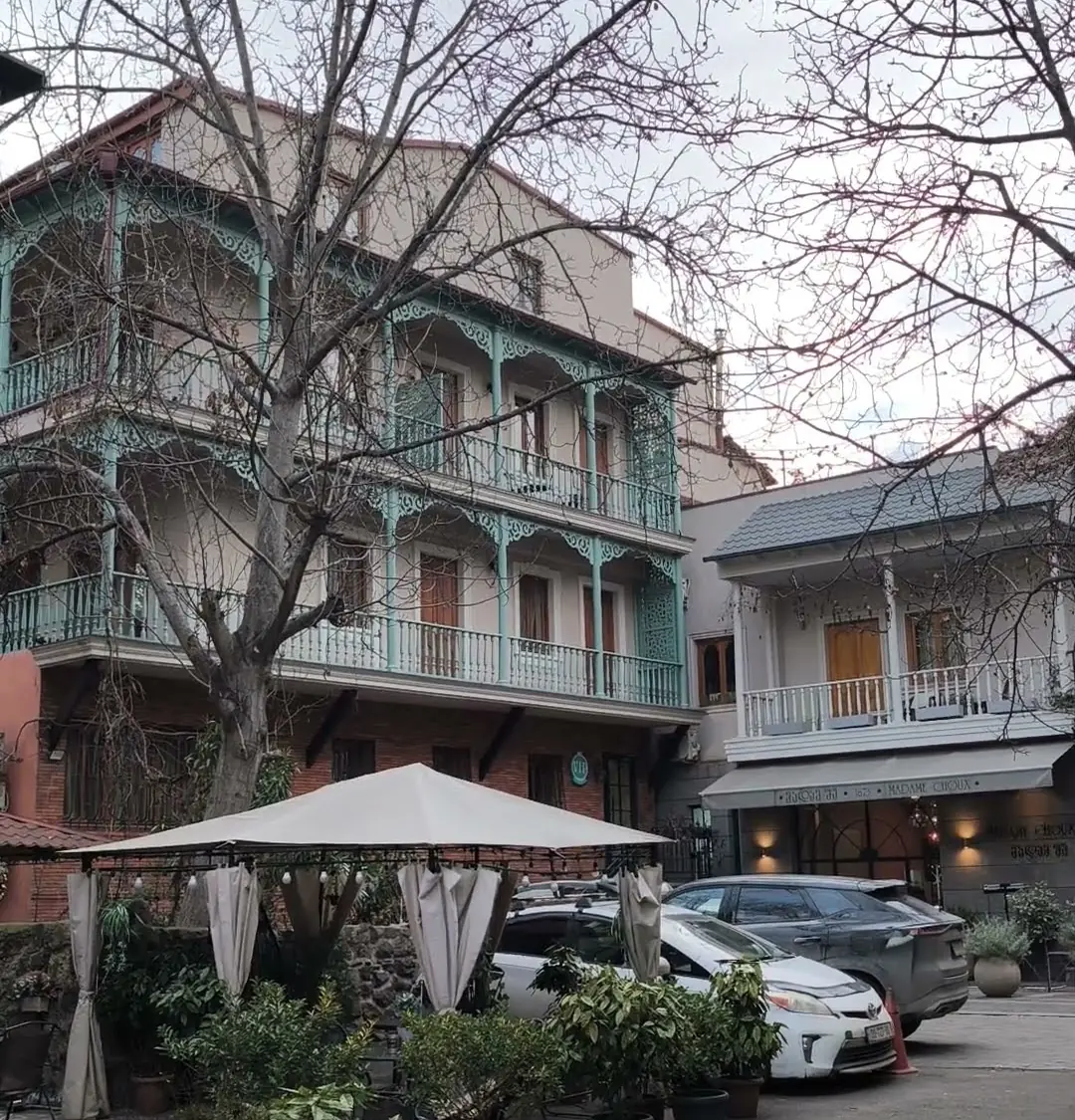
Old Tbilisi is the historic heart of the city — roughly the quarters and suburbs that, until 1936, made up the town then called Tiflis: Abanotubani with Kharpukhi, Kala, Isani-Avlabari, Sololaki, Mtatsminda, Vera, Ortachala, Chugureti and others. Most of the city's sights are gathered here — churches, museums, sulphur baths, narrow lanes hung with carved wooden balconies — and since 24 October 2007 Old Tbilisi has been on UNESCO's tentative list of World Heritage sites.

The city's very name, legend says, was born of hot water. Once there was forest here; a king — in one version, Vakhtang Gorgasali — wounded a roe deer while hunting, and the deer bathed in a hot spring, was healed and got away from the hunters. In another version the king's falcon caught a pheasant, and both birds fell into the spring and were boiled. The healing water and the good lie of the land settled it: the king had the forest cleared and a city built, and it was named after its warm mineral springs — tbili, in Old Georgian tpili, means 'warm'. Later sulphur baths rose over the springs, and that spot is today's Abanotubani.
Excavations show that people lived here as early as the fourth millennium BC. In the second half of the fourth century AD a fortress was built here, and in the fifth century Vakhtang Gorgasali restored and built up the town — which is why he is considered the founder of Tbilisi. His heir Dachi Ujarmeli finished the city wall early in the sixth century and, as his father had willed, moved the capital from Mtskheta to Tbilisi. The first inhabitants settled by the sulphur springs, near today's Gorgasali Square, and beside them a second quarter, Kala, grew up with its fortress as early as the fourth century. The city lay on trade routes, and for centuries Persians, Khazars, Arabs, Seljuks, Khwarazmians, Mongols and Timur fought over it. In 1122 David the Builder freed Tbilisi and made it the capital of a united Georgia; in the twelfth and thirteenth centuries up to 80,000 people lived here.
Above the old town, on a long rocky crest of the Sololaki Range, stands a fortress that has been called Kala, Shuristsikhe and Maghlatsikhe down the centuries. The familiar name Narikala first appears in the seventeenth century: in Persian narin kala means a citadel, an inner fortress. Many fortresses had their own narikala then — at Dmanisi, Gori, Sighnaghi — but in time the name stayed with Tbilisi's alone. In those same years the Turkish traveller Evliya Çelebi described it, with some exaggeration: walls sixty cubits high, seventy towers, three thousand merlons, six hundred houses inside, the khan's palace, a mosque, a caravanserai, a bathhouse, and to the east, natural hot water. In 1795, during the Battle of Krtsanisi, the fortress was badly damaged; the earthquake of 1827 brought down its walls and towers, and in 1847 a gunpowder store exploded and destroyed almost every building in Narikala, the Church of St Nicholas among them. Between 1990 and 1997 a new church rose on the old one's foundations.

On the right bank of the Mtkvari, where the climb to the Botanical Garden begins, lies Abanotubani, the quarter of the baths. As early as the tenth century the Arab geographer Ibn Hawqal wrote that Tbilisi had baths like those of Tiberias, whose water boils without fire. Historical records speak of 65 mineral-water baths in the city in the thirteenth century; Marco Polo wrote about them, as did the Russian merchant Vasily Gagara and Vakhushti Bagrationi. Most of the baths that survive were built in the seventeenth and eighteenth centuries under the influence of Iranian architecture. People did not come only to be cured: townsfolk would spend the whole day here, bathing, resting and feasting, and future mothers-in-law came to look over the beauty of a prospective bride. The baths and bazaars were where people met and traded news, and in the seventeenth century the city had its own merrymaking — Qeenoba, Berikaoba, Qabakhi. In 1795 the troops of the Iranian shah Agha Mohammad Khan took and sacked Tbilisi, and very little of the city as it was before the nineteenth century has survived.
Every October Old Tbilisi becomes the heart of Tbilisoba, the city's autumn festival. It was first held on 28 October 1979. It was conceived on the initiative of Eduard Shevardnadze, then First Secretary of the Communist Party of the Georgian SSR, as one of the new 'socialist traditions', but it became a celebration of the city's fifteen-hundred-year history. It lapsed in the troubled early 1990s, was revived in the second half of that decade and has been held every year since. Tbilisoba borrows the customs of old Georgian festivals — Berikaoba, Qeenoba, Teletoba, Maisoba: folk songs and dancing fill the streets, people from all over Georgia come to the fair of the harvest and the Rtveli, each region with its own, and in these days distinguished people are named honorary citizens of Tbilisi.


