
Videos from here


The story of the place
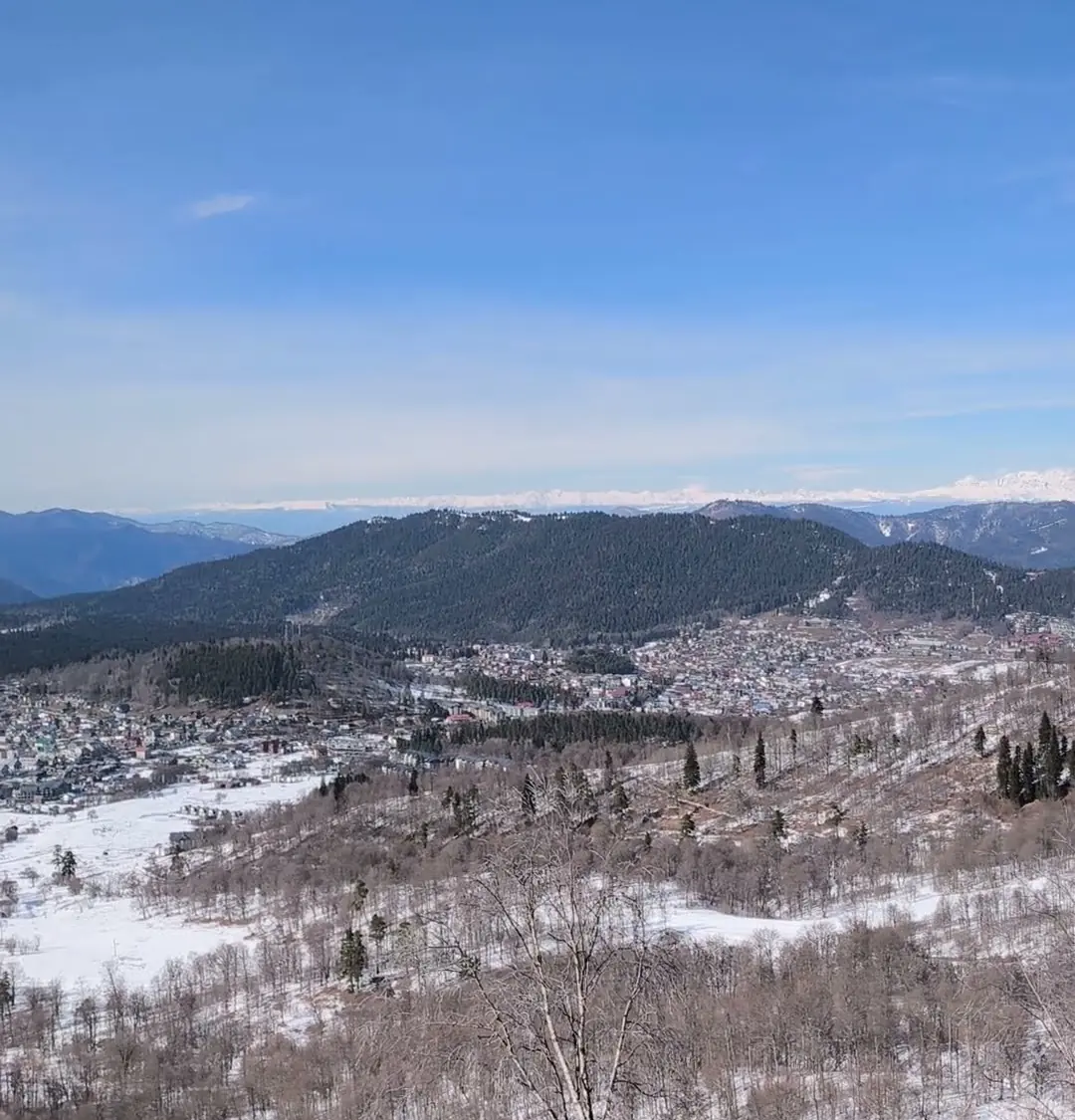
A village on the northern slope of the Trialeti Range, about 1,700 metres up and thirty kilometres from Borjomi. It spreads across the floor of the Bakuriani basin, built of lava once poured out by the Mukhera volcano, and conifer forest stands all around. People came here in deep antiquity: traces of a megalithic culture have been found in Bakuriani, and the Pantnari church survives from the early Middle Ages. Today it is a well-known mountain resort and ski centre.
The first people to settle in Bakuriani were Ukrainians. In 1816, 460 Ukrainian families settled in the Borjomi Gorge; some eighty of them stayed in Bakuriani and the rest in Tori and Andeziti. They felled and worked timber, and the local wood went to Germany to be made into musical instruments. Bakuriani still has places called 'kurumsebi', from the Georgian for 'deaf Russians'.
At the turn of the 19th and 20th centuries a narrow-gauge railway was laid from Borjomi to Bakuriani, and the village began to grow with it. Between the Tsagveri and Tsemi stations the line crosses a viaduct designed in the office of Gustave Eiffel, the man behind the Eiffel Tower; one of the engineers on its construction was Vissarion Keburia, Georgia's first aviator. Steam engines worked the line until 1966, when it was electrified. Films were shot on this little railway, among them Georgiy Daneliya's 'Don't Grieve'.
The railway made the botanists' work easier too. Early in the 20th century a high-mountain botanical garden was laid out on the slope of Mount Kokhtagora under Rolov and Fomin; in 1937 it was planted on a new site. The garden studies how the plants of the Caucasian high mountains take to cultivation, and its alpine collection alone holds some 1,200 species brought from all over the Caucasus.
Skiing was booming in Europe in those years, and Giorgi Nikoladze — son of the public figure Niko Nikoladze, a mathematician, gymnast and mountaineer who organised an ascent of Kazbek — dreamed with his friends of bringing the sport to Georgia. He was the first to bring Georgian skiers to Bakuriani. In 1926 Bakuriani became an urban-type settlement, in 1932 the first ski base opened, and on 6 January 1935 a mountain ski school and a sports house were opened with ceremony — the year counted as Bakuriani's birth as a ski centre. Students came up from Tbilisi to train, and Soviet newspapers called the village 'the capital of Soviet skiing' and 'the Soviet Davos'.
In 1950 a 45-metre ski jump was built, then a 75-metre one, and in 1954 the first tow lift in the Soviet Union began running here. Today cable cars climb from the village up Kokhtagora and to the Tskhratskaro Pass, and the Didveli runs have artificial snow. In 2005 Bakuriani was one of the candidates to host the 2014 Winter Olympics.


