Videos from here



The story of the place
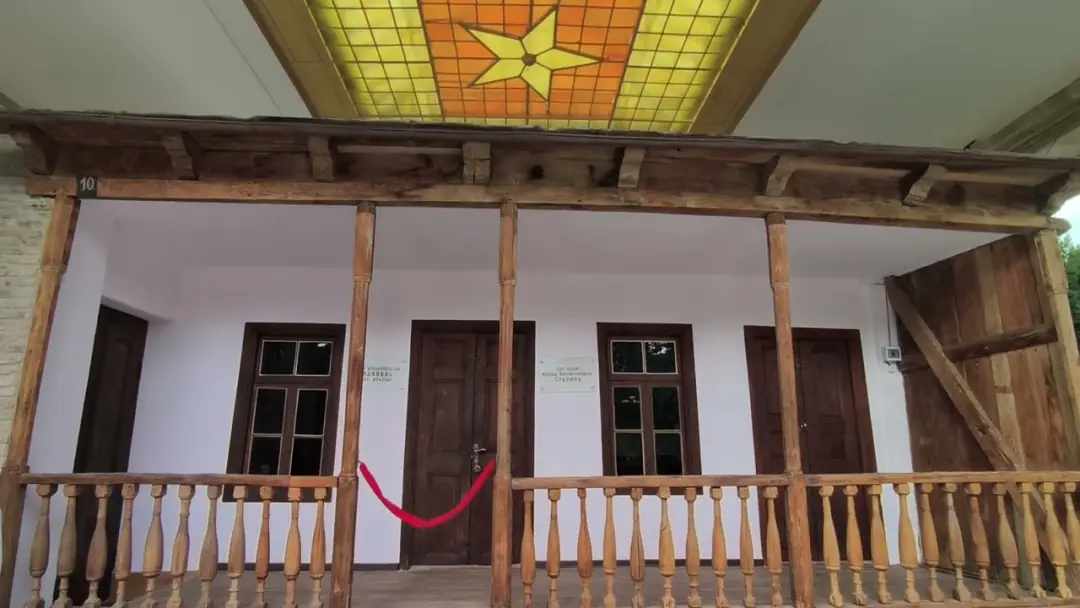
In the centre of Gori, under a pavilion, stands a small wooden house of two rooms. The landlord lived in one. The other was rented by a shoemaker, Besarion Jughashvili, who kept his workshop in the basement. Here he and his wife Keke (Ekaterine Geladze) had a son, Ioseb — the future Stalin. His two elder brothers, Giorgi and Mikheil, died as infants. Ioseb lived in this house for his first four years. He later studied at the Gori church school, graduated from it in 1894 and entered the Tiflis Theological Seminary.

Gori is many centuries older than the house. The town lies where the Liakhvi flows into the Kura, and it takes its name from the rocky hill in its centre, crowned by a fortress. The chronicler Juansher mentions Gori in his account of the 7th century. According to legend, Archil, son of the erismtavari Stephanoz, buried part of the treasure he had inherited here, and the hiding place was called "Tontio" — "the golden mountain". Later David the Builder settled merchants and craftsmen in Gori, and it became a royal town.

The Jughashvili house once stood in a row of others like it. In Soviet times the neighbouring houses were pulled down to make room for new housing, a square and a museum. The house itself was restored, covered with a pavilion and opened as a museum in 1937.
In the early 1950s, work began next to it on a palace in the Stalinist Gothic style, with a tower. Today the museum holds tens of thousands of exhibits, among them Stalin's personal belongings. Beside the museum stands Stalin's own armoured railway carriage, which weighs 83 tonnes. He travelled in it to Tehran and Yalta. The carriage was brought to Gori in 1985 from the railway yards of Rostov-on-Don.
After the war of August 2008, in which Gori suffered badly, Georgia's minister of culture announced that the museum would become a Museum of Russian Aggression. A banner was hung at the entrance calling the museum a falsification of history and a typical example of Soviet propaganda. The banner was later taken down, and since 2010 the museum has also had a room about the years of repression. But the museum was never remade as a whole: in 2012 the town assembly dropped the plans.
From 1952, while Stalin was still alive, his statue stood on Gori's main square: six metres tall on a nine-metre pedestal. On 25 June 2010, at two in the morning, the authorities took it down, though some of the townspeople were against it. It was meant to be set up again in the museum's courtyard, but it never was.