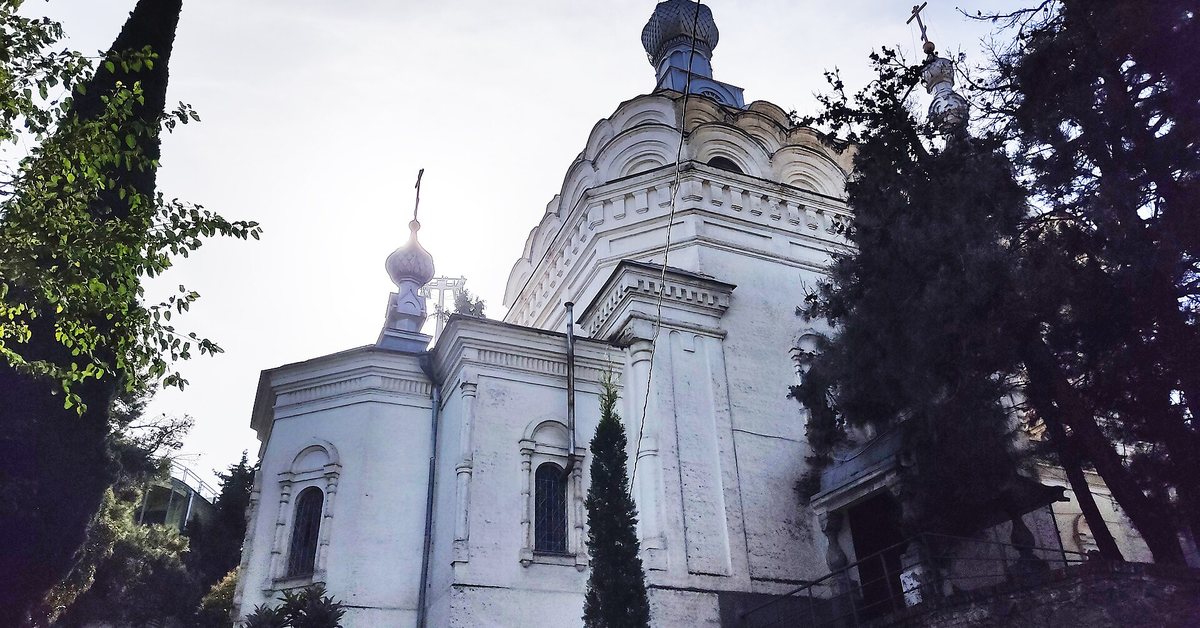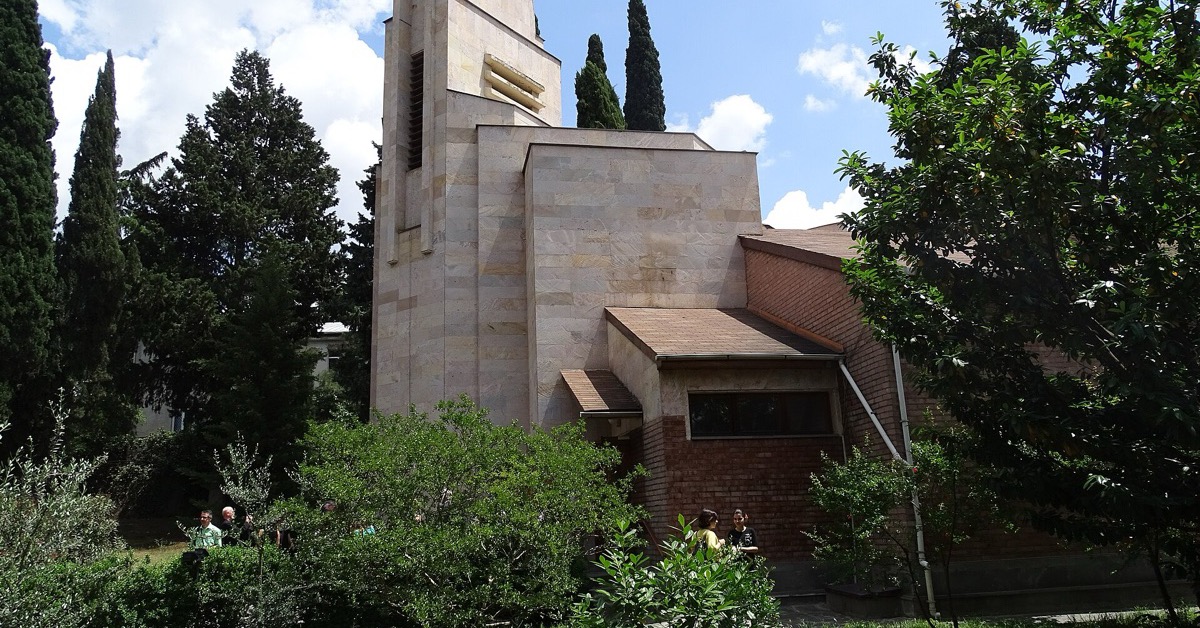
Soviet Tbilisi
The underground, Rustaveli Avenue and seventy years
Under an ordinary house in Avlabari a secret printing press ran for over two years: you reached it down a well with water in it, then along a tunnel.

From February 1921 to April 1991 Tbilisi was the capital of Soviet Georgia, and many turns of those seventy years passed through one spot on Rustaveli Avenue. In February 1921 the cadets who had defended the city from the Red Army were buried here, in the yard of the military cathedral. In 1930 the cathedral was pulled down and the House of Government built in its place, and the city’s story will come back to this building more than once. This story walks through the places of those years, from the underground of the early century, where the young Ioseb Jughashvili began, to this square.
- Former Theological Seminary building ↗
- Tiflis Physical Observatory ↗
- Avlabari printing press ↗
- Freedom Square, formerly Erivan Square ↗
- Former cadet school building ↗
- Site of the Alexander Nevsky Cathedral, now the Parliament building ↗
- IMEL building ↗
- Writers’ House ↗
- Mikheil Javakhishvili House Museum ↗
- Rustaveli Theatre ↗
- Metekhi church ↗
- Mtatsminda Pantheon ↗
- Former House of Communications ↗
- Site of the Church of Sts Peter and Paul ↗
- Rustaveli metro station ↗
- University’s first building ↗
- Kashveti church ↗
- 9 April Garden ↗
Timeline
- 1894 Jughashvili enters the Tiflis seminary
- 1899 His seminary years end; work at the observatory
- 1901 Police come for him at the observatory
- 1904 The secret press in Avlabari starts printing
- 1906 The gendarmes find the press
- 1907 The raid on Erivan Square
- 25 February 1921 The Red Army enters Tbilisi
- 1930 The military cathedral on Rustaveli is pulled down
- 1937 The year writers and artists are shot
- 9 March 1956 Shooting at the House of Communications
- 1966 The Tbilisi metro opens
- 14 April 1978 Georgian stays the state language
- 9 April 1989 The rally at the House of Government is broken up
- 9 April 1991 The act restoring independence
The seminary and the observatory
on the mapThe newspaper Iveria printed Georgian poems signed “Soselo”; the poet Ilia Chavchavadze, the paper’s editor, chose them for print himself. They were written by a seminarian from Gori, Ioseb Jughashvili, the future Stalin. And his friends, as his schoolmate Ioseb Iremashvili recalled, he told to call him Koba, after the hero of Alexander Kazbegi’s novel The Patricide.
He entered the Tiflis Theological Seminary in 1894. The seminary ran from 1817 to 1917, and its house by today’s Freedom Square was built in the 1830s to a design by Bernardazzi; early in the 20th century the seminary moved to Vake, and since 1950 the house has held the Fine Arts Museum of Georgia. Today the building awaits restoration and has been closed to visitors for several years.

In May 1899 his time at the seminary ended, but how is told in different ways. The seminary’s journal records him “expelled… for non-appearance at examinations”. The official Soviet chronicle of his life said he was expelled “for propagating Marxism”, while the historian Simon Sebag Montefiore writes that he simply left and never came back.
From late 1899 Jughashvili worked and lived at the Physical Observatory, which kept watch on the weather and the Earth’s magnetic field. His school friend Vano Ketskhoveli already worked there; he later recalled that they had to keep awake all night and make observations at set hours. The observatory itself dates from the 1830s. In its first years its hourly readings were taken by a gymnasium pupil, the future poet Nikoloz Baratashvili. In 1861, after several moves, the observatory took a building on today’s Davit Aghmashenebeli Avenue, no. 150; it now stands on the grounds of the Ministry of Defence.

The gendarmes kept an eye on Jughashvili: their records, quoted by the historian Bertram Wolfe, describe him as “employed at the Tiflis Observatory, intellectual, has connections with railwaymen”. On the night of 21 to 22 March 1901 the police arrested several Marxists in Tiflis and came to the observatory for him. Montefiore tells how he was riding back on a tram, saw police around the building and stayed on. He never came back here and from then on lived underground.
In Soviet times a monument to Stalin stood in the observatory’s garden; it was removed in the 1960s.
Sources (11)
- Википедия (ka): Тбилисская духовная семинария
- Википедия (ru): Тбилисская духовная семинария
- Национальный музей Грузии: Музей изобразительных искусств, 2024
- S. Sebag Montefiore, «Young Stalin», 2007
- E. E. Smith, «The Young Stalin», 1967
- Биографическая хроника И. В. Сталина (Сочинения, т. 1), англ. перевод, архивная копия
- B. Wolfe, «Three Who Made a Revolution», 1948
- I. Grey, «Stalin, Man of History», 1979
- Википедия (en): Early life of Joseph Stalin
- Википедия (ka): Тбилисская геофизическая обсерватория
- Википедия (ru): Тифлисская физическая обсерватория
The press under the well
on the mapOn 15 April 1906, during sweeping searches across the city, the gendarmes came to an empty house on the edge of town, in Avlabari: its tenants had left three days before. A man was lowered into the well, and three sazhens down he found a side passage. It led to a secret printing press that had been working under this house for more than two years.
In 1903 the Caucasian Union Committee of the Russian Social Democratic Labour Party gave Mikho Bochoridze the job of setting it up. The city gave leave to build a dwelling house on a remote plot, and a secret room was dug under its cellar: you went down a well with water in it, along a tunnel and up a second well. In January 1904 a printing machine, brought from Baku in pieces, was installed underground. Bochoridze’s aunt, Babe Lashadze-Bochoridze, kept house there; an alarm line ran from her room to the press below. It printed in Russian, Georgian and Armenian.

The search turned up type in three languages, a laboratory for explosives and three loaded bombs. The premises were burned, the cellar blown up, and the owner of the plot arrested. What led the gendarmes to the well is told in different ways: Sergei Alliluyev recalled a burning scrap of paper that the draught from the cellar pulled aside, the gendarme colonel’s report names fuses wrapped in printed sheets, and the newspaper Zaria Vostoka in 1937 and the historian Montefiore an informer.
On 16 November 1935 the Central Committee of the Georgian Communist Party ordered the press restored as the place “where Comrade Stalin’s first works were printed” in 1903–1906. The house on Kaspi Street was rebuilt on the old site, and on 20 August 1937 a museum opened in it; in 2012 it passed to the National Parliamentary Library. And when the architects came to the plot in 1936, its owner still lived beside the pit the blast had left, and the old printers and Babe herself came to show them where everything had stood.
Sources (7)
- «Заря Востока», 20.08.1937, № 190
- И. Хвадагиани, «Авлабарская нелегальная типография-музей», SovLab, 2011 (груз.), архивная копия
- «The Alliluyev Memoirs», пер. D. Tutaev
- S. Sebag Montefiore, «Young Stalin», 2007
- E. E. Smith, «The Young Stalin», 1967
- M. Ellena, «Stalin’s secret flyers», Chai Khana, 2017
- Национальная парламентская библиотека Грузии: адреса
The robbery on Erivan Square
on the mapOn 26 June 1907, at about half past ten in the morning, phaetons crossed Erivan Square: the State Bank’s cashier was taking money from the post office to the bank. “By some strange chance,” the newspaper Kavkaz wrote afterwards, there were no trams on the square at that moment. The raiders were in place early: some stood by the Pushkin Garden and the military headquarters, others sat in the Tilipichuri restaurant in the Tamamshev caravanserai on the square itself. When the phaetons appeared, bombs were thrown at them, eight blasts in all, revolvers were fired, and the money was seized. It was carried off by Kamo, Simon Ter-Petrosian, in an officer’s uniform, in a phaeton.
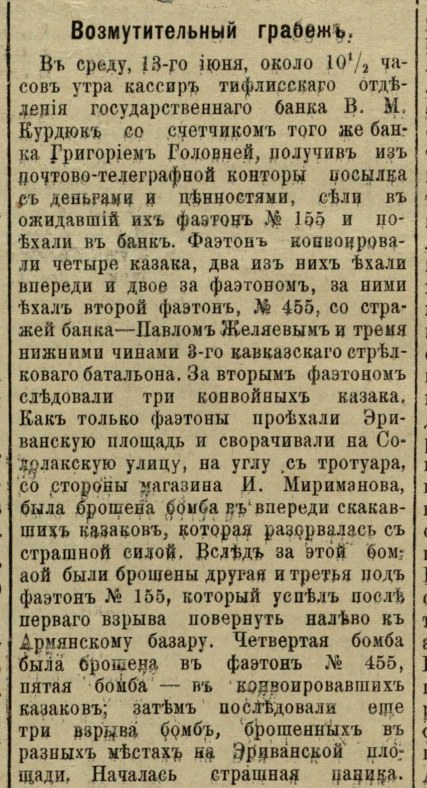
The square, today’s Freedom Square, was then called Erivan Square, after General Ivan Paskevich: for taking the fortress of Erivan, as Yerevan was then called in Russian, he was made Count of Erivan. The square has changed both its names and its monuments since: a monument to Lenin was put up on it in the 1950s and pulled down in the early 1990s.

The raid was planned by Bolsheviks with Lenin’s consent, though a few weeks earlier the party’s London congress had banned such expropriations. When the money would move, the raiders learned from their own people at the post office. One of them, Jughashvili’s schoolmate Voznesensky, told a party inquiry in 1908 that he had helped only for Koba’s sake, whose poems he admired. Rumours of a raid were already going round the city, and the State Bank’s manager asked the authorities to take measures, but no one took him seriously.
More than a quarter of a million roubles was taken: Kavkaz wrote the next day of 250,000, while the historian Montefiore says the bank itself did not know whether it had lost 250,000 or 341,000. The numbers of the 500-rouble notes were sent round the banks, and several party members were arrested abroad trying to change them. As for the money itself, Netgazeti writes, it was hidden under the Tiflis observatory until autumn, then packed into wine barrels topped up with red wine and sent off by express train. What part Jughashvili himself played is little known: there is no direct evidence, though, in the words of the historian Irakli Makharadze, “everyone says” he was at its head, while the stories that he was seen in the Tilipichuri that morning or threw the first bomb from a roof Makharadze takes for invention.
Makharadze and Lasha Khetsuriani count three killed on the square itself and three more the same day, by a bomb a boy found in rubbish and carried into a shoemaker’s workshop; Montefiore writes that, by the Okhrana’s archives, about forty died. More than fifty were wounded, by the rumours Kavkaz passed on. Gigo Kasradze, who worked at the post office and helped the raiders, wrote: “The whole city is shaking… People run wherever they can, many rushed to the post office… The whole of Erivan Square is in flames.”
February 1921
on the mapIn February 1921 the Red Army came up to Tbilisi, capital of the Democratic Republic of Georgia. On 17 February Colonel Alexander Chkheidze, head of the military school, led the cadets out of the school yard on the avenue that now bears Aghmashenebeli’s name and marched them to Tabakhmela. There were about a hundred and fifty cadets: the newspaper Tbiliskaya Nedelya writes of 152 of the school’s 560 men at the front, the outlet Civil Georgia of 166 of the 180 enrolled. The first big attack on their positions began on 19 February.
One of the cadets, Shalva Eristavi, aged twenty-two, crept up to an enemy machine gun during an attack, bayoneted its gunner and covered the gun with his body. His father carried his son’s body off the battlefield in a sack and buried him in secret in what is now Vere Park; the city hall set a gravestone there in 2010. On 23 February the dead were buried before a great crowd: the procession with the coffins went through Vere and along Rustaveli Avenue to the military cathedral, the head of the government, Noe Zhordania, met it at the entrance, Catholicos-Patriarch Leonide held the funeral service, and the dead were laid in a common grave in the cathedral yard.
Late on the night of 24 February General Kvinitadze, who commanded the army, ordered Tbilisi abandoned so that the army would not be surrounded, and on 25 February units of the 11th Red Army entered the city. The cadets fell back with the army all the way to Batumi. On 17 March the Constituent Assembly, sitting there, charged the government with carrying on abroad, and on the night of 17 to 18 March the government, part of the Assembly, the command and the cadets left Batumi on Italian ships. The house at 148 Aghmashenebeli Avenue, where the school was, bears plaques; one says that Colonel Chkheidze later became a general of the Polish army and was shot at Katyn in 1940.

Today 25 February is Soviet Occupation Day in Georgia, as parliament declared it in 2010. On this day flags fly at half-mast and a minute’s silence honours the victims of the occupation. Kojori has been within Tbilisi’s boundaries since 2007, and every year wreaths are laid at the cadets’ memorial there.
Sources (8)
- М. Эбралидзе, «Тбилисская юнкерская школа и судьбы её воспитанников», «Тбилисская неделя», 2014, № 14
- Civil Georgia, 2024 (груз.)
- Civil Georgia, «Республика 100»: похороны 23 февраля 1921 года (груз.)
- Civil Georgia, «Республика 100»: 17 марта 1921 года (груз.)
- Civil Georgia, «Республика 100»: 18 марта 1921 года (груз.)
- Постановление парламента Грузии от 21.07.2010 (груз.)
- Википедия (ka): Коджори
- Georgia Today, 25.02.2026
Rustaveli Avenue
on the mapOn 7 February 1930 the newspaper Komunisti printed a picture of the military cathedral on Rustaveli: the roof had already been stripped from its main dome. The Alexander Nevsky cathedral, in whose yard the cadets were buried, had been built to mark the end of the Caucasian War and consecrated on 21 May 1897, a day chosen to match the date the war had ended. Now it was being taken apart, and the House of Government of the Georgian SSR was built in its place. The upper block, designed by Viktor Kokorin and Giorgi Lezhava, was finished in 1938, the block along the avenue in 1953; Vladimir Nasaridze worked on it too. The building carries motifs of Georgian architecture and is faced with golden Bolnisi tuff. Kandid Charkviani, then first secretary of the Communist Party, recalled that this was his idea: until then the only building in Tbilisi faced with such tuff had been Sioni Cathedral. Today the building houses Georgia’s parliament.

In the same years the building of the Tbilisi branch of the Marx–Engels–Lenin Institute rose on the avenue. The competition for its design was held in 1933 and won by Alexei Shchusev, who in 1941 received a Stalin Prize for the building. It was built from 1934 to 1938 and also faced with Bolnisi tuff. In 1990 the reliefs were knocked off its facade. From 1992 to 1995 parliament sat here, and on 24 August 1995 it adopted Georgia’s constitution in this building. In 2007 the building was sold, and the new owner began to tear it down without a permit. Today the tower of the Biltmore hotel rises behind the old facade.

Sources (8)
- Радио Свобода, «Собор на месте парламента», 2021 (груз.)
- Грузинская энциклопедия: Гиорги Лежава (груз.)
- Tbilisi Architecture Archive: Government Palace
- Мэрия Тбилиси: здание парламента (груз.), архивная копия
- А. Элисашвили, «ИМЭЛ», SovLab, 2011 (груз.), архивная копия
- Tbilisi Architecture: IMELI building, 2013
- Конституция Грузии, первоначальная редакция (груз.)
- Правительство Грузии, 31.07.2016 (груз.), архивная копия
1937
on the mapOn 22 July 1937 a meeting was under way at the Writers’ House at 13 Machabeli Street; at such meetings writers then passed sentence on one another. This mansion of Davit Sarajishvili, founder of Georgia’s brandy making, had been handed to the writers in 1921 at the instigation of the poet Paolo Iashvili, one of the leaders of the Blue Horns symbolists. Now Iashvili walked out of the hall and shot himself with a hunting gun. The day before, Novaya Gazeta writes, Lavrenti Beria, then first secretary of Georgia’s Communist Party, had summoned him, shown him “testimony” beaten out of prisoners and “advised” him to write an article exposing as an enemy of the people his fellow Blue Horns poet Titsian Tabidze.

The Writers’ Union condemned his act, and only the writer Mikheil Javakhishvili spoke of his courage. On 26 July the Union’s presidium voted to expel Javakhishvili and to have him “physically annihilated”; only Geronti Kikodze was against: he walked out of the hall rather than raise his hand. On 14 August Javakhishvili was arrested, on 30 September shot. His family was left one glazed gallery of 25 square metres of their flat. Now the flat where the family had lived since 1913 is a museum; the house stands on the street that bears the writer’s name, and the museum is open every day. Titsian Tabidze was arrested in October of the same year and never came home; his family was told he had died of pneumonia.
The Rustaveli Theatre, on the same avenue, had lost its director even earlier. From 1926 to 1935 it was run by Sandro Akhmeteli. He staged Anzor, Lamara and The Robbers here, and its tours to Moscow made the theatre famous. In 1935 he was removed and left for Moscow. On 19 November 1936 he was arrested there and taken back to Tbilisi. For three months he denied everything, and after torture he named more than two hundred “accomplices”, the whole company among them. On 28 June 1937 he was sentenced to be shot; four members of his theatre’s staff were sentenced to death the same day, and his wife to ten years. In 1956 he was rehabilitated.
The painter Dimitri Shevardnadze founded the National Gallery in 1920 and in 1933 moved it to Metekhi castle. In 1936 he was removed from his post. When, for the Rustaveli jubilee in 1937, Metekhi church was to be blown up and a monument to the poet put up in its place, he and others spoke against it; the same year he was arrested and shot. Metekhi church still stands above the Kura.

Many of them have no graves. On 21 September 2011 a symbolic grave of writers and artists repressed in 1937 was unveiled in the Pantheon on Mtatsminda. It bears the names of Sandro Akhmeteli, Titsian Tabidze, Mikheil Javakhishvili, Dimitri Shevardnadze, Vakhtang Kotetishvili and Evgeni Mikeladze.
Sources (13)
- «Дело Ахметели», «Архивный вестник» МВД Грузии, 2008, № 1
- Грузинская энциклопедия: Сандро Ахметели
- Театр Руставели: история
- Дом писателей Грузии (груз.)
- D. Rayfield, «The Literature of Georgia»
- D. Rayfield, «Stalin and His Hangmen»
- C. Barnes, «Boris Pasternak: A Literary Biography», т. 2
- H. Gutbrod, «Paolo Iashvili and the Writers’ House of Georgia», Investor.ge, 2023
- «Новая газета», 14.07.2019
- Союз тбилисских музеев: дом-музей Михаила Джавахишвили
- Национальный музей Грузии: Димитрий Шеварднадзе
- T. de Waal, «The Caucasus: An Introduction»
- Грузинская энциклопедия: Мтацминдский пантеон (груз.)
March 1956
on the mapOn 5 March 1956, the third anniversary of Stalin’s death, a procession of students, some 120 to 150 of them, bare-headed, went through Tbilisi; the front row carried a portrait of Stalin. So the Trud correspondent Statnikov described it in a secret letter. Shortly before, on 25 February, at a closed session of the party’s 20th Congress, Nikita Khrushchev had given a speech condemning Stalin’s cult of personality. Already on 4 March people had brought flowers and wreaths to Stalin’s monument on the Kura embankment, and from 6 March portraits of Lenin joined Stalin’s. Rallies went on at the monument and on Lenin Square, today’s Freedom Square, under the slogans “Glory to Stalin!” and “We won’t forget Stalin”.
On the evening of 9 March about ten people were sent from the rally at the monument to the House of Communications on Rustaveli Avenue to send a telegram to Moscow. What it said, the Interior Ministry’s reports do not tell; an eyewitness, the journalist Valery Kadzhaya, recalled that it was a birthday greeting to “Comrade Molotov, great Stalin’s faithful friend and comrade-in-arms”. They were let into the building and detained “for identification”. The crowd moved to free them, and shooting began: Statnikov wrote that someone in the rear ranks fired at the soldiers, and the soldiers guarding the building opened fire with automatic weapons. Towards morning on 10 March troops with tanks broke up the rally at the monument. By the figures of Georgia’s Interior Ministry, 15 people were killed at the House of Communications and the monument and 54 wounded, seven of whom later died; KGB internal letters give 21 dead, and the victims’ society speaks of more than a hundred. Every year on 9 March relatives of the dead and eyewitnesses gather at the site of those events.
The city after the war
on the mapA German church stood on Marjanishvili Square. After the war the authorities made German prisoners of war take it down and build houses in its place; Georgia’s tourism portal speaks of two identical houses, and its Georgian page says the church’s stone went into them. The houses were built in 1947–1948 to a design by Mikheil Melia and are lived in to this day; in 2013 a plaque in memory of the church was put up on one of them.

A few years later, in the early 1950s, a reservoir was filled where salt lakes had been: the Tbilisi Sea. Its water goes to the fields and into the city’s mains.
At the same time work began on the metro, and on 11 January 1966 the first line opened: six stations from Didube to Rustaveli. The Tbilisi metro was the fourth in the Soviet Union and the first in the Caucasus. It was opened at Rustaveli station, the deepest in the city; its second escalator is the longest in the Tbilisi metro, 123 metres.
Sources (8)
- Georgia Travel: площадь Котэ Марджанишвили
- Georgia Travel: площадь Котэ Марджанишвили (груз.)
- Грузинская энциклопедия: Евангелическо-лютеранская церковь (груз.)
- Википедия (ka): Тбилисское море
- Википедия (ru): Тбилисское водохранилище
- Грузинская энциклопедия: Тбилисский метрополитен (груз.)
- Тбилисская транспортная компания: история (груз.)
- Н. Генгиури, «Станции тбилисского метро», «Академия», 2022, № 8–9 (груз.)
April 1978
on the mapOn 14 April 1978 a session of the Supreme Soviet of the Georgian SSR met in the House of Government to adopt a new constitution. In the published draft Georgian was no longer called the state language. Many proposed keeping the old article, among them the linguist Akaki Shanidze, and signatures were collected at the university and institutes.
That day demonstrators, mostly students, marched from the university along Rustaveli Avenue to the House of Government: A Chronicle of Current Events wrote of several thousand, The New York Times of more than twenty thousand. Soldiers and police lined the route. The Communist Party’s first secretary, Eduard Shevardnadze, spoke in those days of 9 March 1956. When he addressed the crowd with “My children, what are you doing?”, the answer, as eyewitnesses told it, was “We are not your children.”

In the evening Shevardnadze read out to the crowd the final text of the article, in which Georgian remained the state language, printed sheets with it were handed round, and people began to go home. The next day the cameraman Avtandil Imnadze, who had filmed the demonstration, was arrested; in December he was convicted of “anti-Soviet agitation”. Since 1990, 14 April has been Mother Language Day in Georgia.
9 April
on the mapEleven years later, in late March 1989, a rally of many days began at the same House of Government; from 6 April it demanded that Georgia leave the USSR, and more than a hundred people were on hunger strike. On the night of 9 April, 45 minutes before the dispersal, Catholicos-Patriarch Ilia II spoke to the people; he recalled that he called on everyone to go into Kashveti church. The square stood silent for seven minutes, then said the Lord’s Prayer, and did not leave. At four in the morning troops moved on the crowd with truncheons, small infantry spades and gas. Many took refuge in Kashveti church and the garden next to it, now called the 9 April Garden. The commission of the USSR Congress of People’s Deputies chaired by Anatoly Sobchak wrote that 16 people died on the spot and three soon after in hospital; Georgian outlets give 21 dead.
Two years to the day later, on 9 April 1991, Georgia’s Supreme Council at an emergency session passed the act restoring the country’s state independence. Shortly before, in the referendum of 31 March, 99 per cent of those who voted were for independence. Today 9 April is a public holiday in Georgia: the day the act restoring state independence was passed, and the day of national unity, civic accord and remembrance of those who died for the homeland. By the parliament stands a memorial to those who died that night in 1989.
Sources (8)
- Заключение комиссии Съезда народных депутатов СССР по событиям 9 апреля 1989 года, архивная копия
- Interpressnews, 09.04.2019: патриарх о 9 апреля 1989 года
- Civil Georgia, 09.04.2025
- JAMnews, 09.04.2026
- Georgia Travel: сад 9 Апреля
- Акт о восстановлении государственной независимости Грузии, 9.04.1991 (груз.)
- ЦИК Грузии: итоги референдума 31 марта 1991 года
- Трудовой кодекс Грузии, ст. 30 (груз.)
More places
-
 Old Tbilisi
Sulphur baths and the legend of the roe deer
5 videos
-
 Mtatsminda
Tbilisi's Holy Mountain and writers' pantheon
1 video
-
 Tbilisi Sea
A sea filled where salt lakes once lay
1 video
-
 Gori
A fortress on a rock and the house where Stalin was born
4 videos